This month involved a LOT of checking the weather forecast. After an unbelievably wet start to the year, we predictably swung into a dry spell at an inconvenient time for the garden. I’ve also been checking my emails too much, waiting for responses about my faerie book currently in the query trenches (which is living up to its name). But other than that, I’ve been listening to Noah Kahan’s new album on repeat and trying to finish some of the knitting projects that have been sitting half-completed in my basket for… too long. It’s a work in progress!
From the Bookshelf
And there have been so many great books this month! The highlight is obviously the new Murderbot book, Platform Decay. It felt like spending time with a beloved old friend after too long. I also finished The Buffalo Hunter Hunter, which was an utter gut punch, and I can’t stop thinking about the pure evil that was the near eradication of bison in North America, all for the sake of destroying the Native peoples who lived along side them. The Buffalo Hunter Hunter is fiction, of course, but the horror of the real historical context is just as horrifying as the existence of vampires.
As research for my current novel, I read The Wager by David Grann and Sons of the Waves by Stephen Taylor. Both of them cover aspects of nautical history, with The Wager addressing the disaster of a specific shipwreck, while Sons of the Waves takes snapshots of naval life through the 18th and 19th centuries. They take a very different approach to conveying history, each with strengths and weaknesses. The Wager is a kind of narrative nonfiction, with all the various sources compiled into a single story, told very engagingly. But by virtue of being an average of different perspectives, it flattens some of the reality that history cannot be definitively reconstructed, only interpreted. Sons of the Waves, on the other hand, puts the focus on the oft overlooked common ship’s company – the non-officers – drawing from sources written by their hands alone, with a more traditional approach to conveying information. This makes it dryer (though still an enjoyable read) while maintaining the specificity of individual experiences. Overall, I think both books do a good job at what they set out to do.
From the Garden
While the annuals find their feet in the borders and the newly-sown perennials begin to bulk up in pots, there is a chance for the lawn to take centre stage. I am a massive fan of No Mo May, when we’re encouraged to hold of mowing the lawn for the month, letting wildflowers grow as vital food for bees, butterflies and all the other insects that pollinate our plants and feed our birds. It’s a single action (inaction, really!) that can have a lasting positive impact for our local ecosystems.
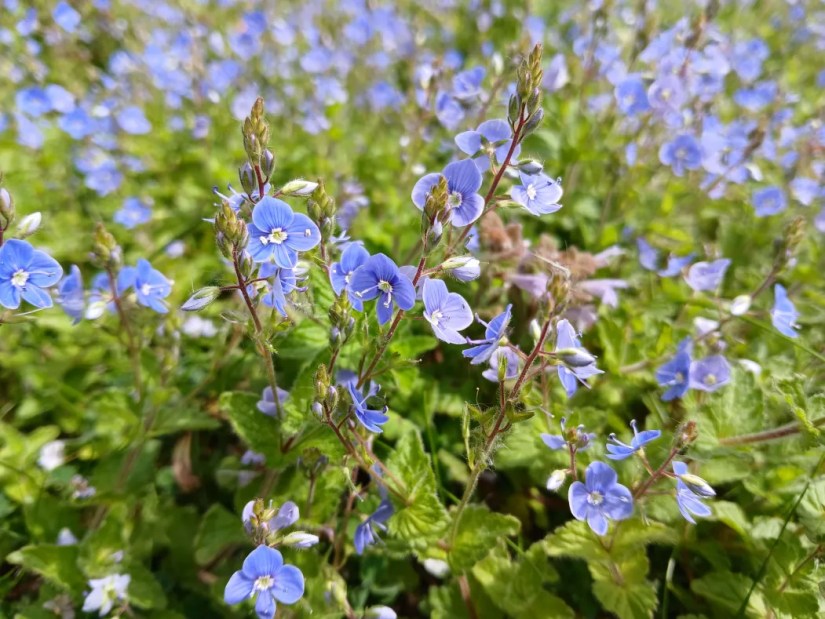
The more you do it, the greater the dividends. If you can let your lawn grow every year for as long as possible between cuts, then you’re likely to see a wide variety of flowers establishing. Daisies, buttercups, dandelions and clover are all common, but a few years of long growing periods has also blessed me with purple-blue carpets of speedwell, the sweet scent of violets, and novel eruptions of tufted vetch and forget-me-nots. Nothing makes me smile like a lawn full of flowers and the many happy bees and butterflies they support.
In keeping with the theme, I’ve also been addressing some patches of lawn that I’ve neglected a little too much, letting them get overgrown with brambles and thistles. The more I ignored it, the bigger the problem got, until the solution was to just dig the whole thing over. While a labour of love, it also gave me the opportunity to pick a grass mix that is better adapted to the dry, nutrient-poor soil than the existing grasses, most of which, at best, barely tolerate these conditions. I chose a mix specifically for chalk grassland, and mixed in seeds for bird’s-foot-trefoil, wild marjoram, clover and a couple of vetch varieties to give the area a bit of pizazz. I’ve experimented with native meadow mixes in the past, to great success in small patches, but this is the first time I’ve tried to pick plants that will mostly function as a lawn instead of, you know, a knee high meadow. I can’t wait to see how it grows in!


